
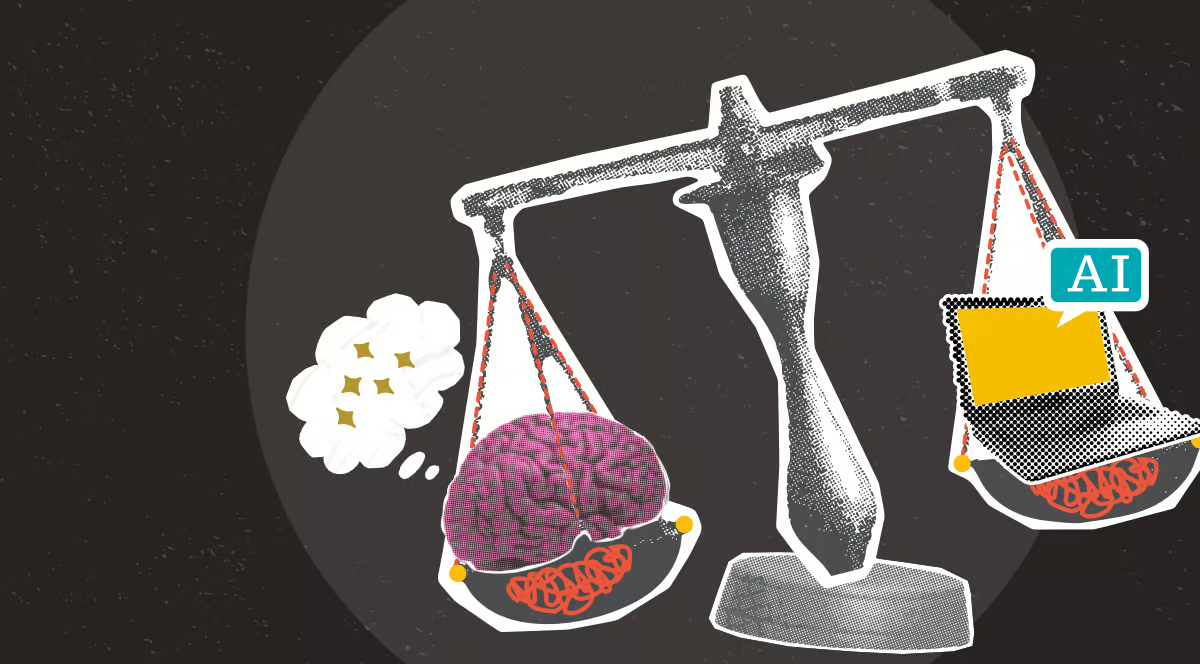
Human Creativity + Ai Capability. Striking a Balance.
Not long ago, we were told Artificial Intelligence was going to revolutionize our lives by making everything faster, better, smarter — and all at our fingertips. While some people had visions of robots walking the dog and folding laundry, some of us began to panic. It got us thinking; instead of doing my chores, what if AI is coming for my job? In fact, a March 2026 Quinnipiac University poll found that 70% of Americans think AI will lead to fewer job opportunities for us humans, a stat that jumped from 14% in 2025.
But reality tells a different story. A recent MIT study says AI is currently capable of replacing just 11.7% of human jobs, but perception is reality, especially in the advertising biz. Which brings me to the big question: is AI ready to “take over” advertising?
My first impression is not quite yet. Anyone who’s monkeyed around with ChaptGPT can tell you its writing and design capabilities still lack one key factor — a human touch. AI may already be remarkably efficient at some tasks — like helping with tone consistency throughout long-form copy — but truly original, generative, innovative creativity isn’t currently on its resume.
Does this mean advertising and creative are the last bastions of AI-proof careers? Probably not. But at least for now, people still want to be talked to like real people, by real people. Marketing is an obvious example because it’s by definition a casual conversion that has to tap into the vibe, nuance, language, and look of the current moment to be relevant. And as ad people, we’re professionals at being humans. At our best, there’s an authenticity and originality in what we do (at our worst, it’s the opposite).
That’s not to say that AI isn’t already making an impact in advertising. It’s a remarkably good tool that’s fantastic at pattern recognition, quickly creating variations, analyzing data, and generating faster and more expansive outputs at scale. Brands are already cranking out AI-based content in droves. But a lot of that volume isn’t exactly being well-received. Because the human touch matters.
For Super Bowl LVIII, Svedka Vodka went all in with an AI spot, and the response was two big human thumbs down. In fact, The Kellogg School Super Bowl Advertising Review gave it a “D” grade. Some viewers and critics called it potentially “the worst Super Bowl ad of all time.” Ouch. If AI had feelings, it might have quit the ad game and put #OpenToWork on its LinkedIn profile.
Nothing knows people like people.
Personally, I write heavily from personal experience. At Tailfin, we create a lot of content for Georgia Natural Gas (GNG). Natural gas is a direct weather-related purchase decision, and as a lifelong Georgian, I know our state’s fickle weather patterns in my bones. I also know how my friends and neighbors and parents and teachers and everyone else I’ve known my whole life talks about this Georgia weather. So when we’re in the throes of a deep south winter, I can remind my fellow Georgians “Don’t freeze your peaches off” on a billboard, and it makes an instant human connection. Tough for AI to replicate that sense of place.
Same goes for bridging the seemingly unconnected gaps in human language. Take another GNG headline, “The early bird gets the therm.” It takes a folksy old adage (early bird) then adds a technical term (therm) via rhyme replacement (worm). Louisiana Hot Sauce pulls a similar trick with “Bayou Some”. It’s not necessarily genius, and it may not win a Pulitzer, but it’s a good example of writing that is uniquely human and uniquely connective. In advertising, that counts for a lot.
Maybe unsurprisingly, as businesses lean more and more into AI, many audiences are craving deeper human connections, gravitating to content that feels personal, real, and rooted in experience. According to the Atlanta Journal Constitution (yes, they’re still around), 63% of Gen Zers are intentionally unplugging (the highest rate of any generation). This shift is fueled by a desire for tangible, “real-life” connections in a heavily digitized world.
Real human connection is what we’re after.
So what’s next? Hard to say. It feels like a classic pendulum swing of embrace-reject-embrace-reject that’s par for the course when it comes to new technology. In the end, “embrace” usually wins, but one thing I do know is we humans are wired for creativity and if we embrace too much artificial intelligence, it has to be doing some damage to our own intelligence. Experts call it cognitive atrophy — and that phrase alone is scary enough to keep me noodling on the next idea.
In the end, the doom-and-gloom predictions of AI coming for all of our jobs makes me think of a quote from one of our most human creators. In 1897, as news outlets reported the news of his alleged passing, Mark Twain retorted, “the report of my death was an exaggeration.” AI is coming, but the end is not nigh.
